Integrating artificial intelligence in a company implies a change in the company’s mindset and vision of the future. Therefore, it is necessary to prepare the team to use AI, which is a must for any SME that wants to take advantage of this frictionless transformation.
Many companies make the mistake of obsessing over the best tool, but the real impact depends on people. In the end, a prepared team integrates AI into their own way of working, making it a natural part of their day-to-day.
Here’s how to do it in a practical way.
Why it is key to prepare the team before working with AI
Adopting AI without preparation often causes friction and rejection in the team because of errors, misuse and unrealistic expectations, which directly affects productivity.
Conversely, when the team understands the purpose, change is natural. In fact, technology adoption improves when people see value in their day-to-day lives.
It’s not about turning everyone into an expert. It’s about giving them context, confidence and clear tools.
Change in mentality
Before talking about tools, we need to work on the mindset. Many people see AI as a threat, others see it as complex.
This is where leadership comes in, the company must communicate the objective well. It is not replacing people, it is empowering their work.
In addition, it is useful to explain specific cases. For example, how a tool can save time in repetitive tasks, this helps to reduce uncertainty.
Practical training
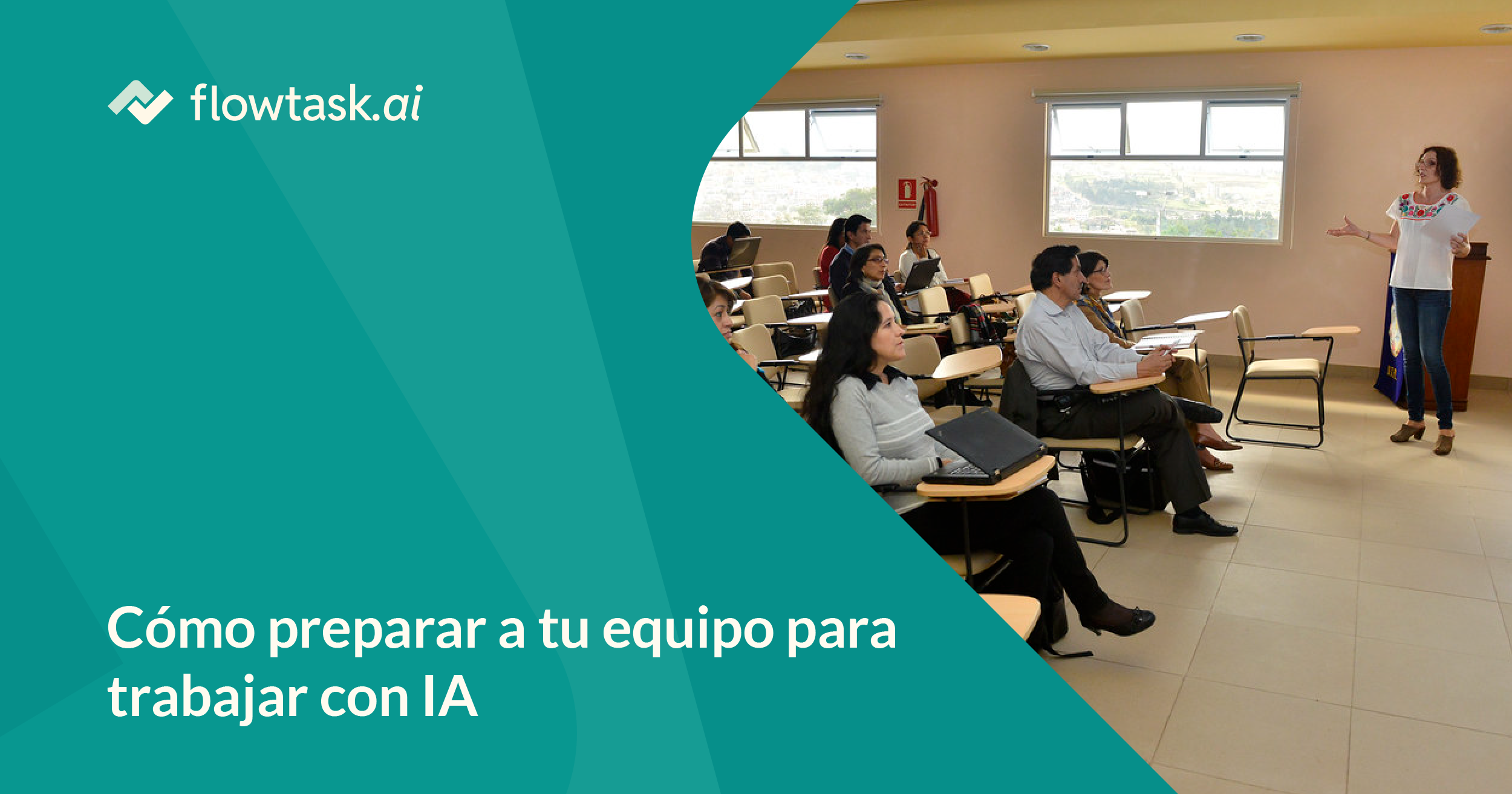
One of the most common mistakes is to offer training that is too general. Talking about AI in an abstract way does not provide real value.
The team needs to learn by doing, i.e. apply AI to concrete tasks in their daily work.
For example, in a marketing team:
- Generate content ideas
- Drafting
- Analyze campaign data
On the other hand, in an administrative team:
- Automate responses
- Classify information
- Generate reports
The key is to adapt the training to each role. This way, learning is useful from day one. In the following resource you can learn how to apply these automations in your own company.
Define clear processes from the beginning
Establishing clear processes from the outset is essential to prevent the use of AI from becoming an improvised and disorganized practice. Therefore, it is essential to define how and when to use it.
The team needs to know exactly:
- Which tasks can be automated
- Which tools to use
- What level of review is required
Without these rules, it is inevitable that each person works in his or her own way, which ends up reducing efficiency and increasing errors.
Use of appropriate tools
Not every tool fits every company. Making the right choice is as important as training the team.
A good tool must be intuitive, integrable with others in the company (SAP Business One, Power BI, Curie Platform, etc.), adapted to the size of the company (and scalable) and must solve real problems. It makes no sense to work with AI just for the sake of trend.
An example of this is an SME that can start with simple solutions, automating basic tasks and generating impact. This provides a better understanding of the real potential of AI in business.
Leadership
The team watches what the leaders do. If management doesn’t use AI, the rest won’t either. That’s why change must start at the top.
Managers should use tools in their day-to-day work, share results,
encourage learning and create a safe environment. It is important that the team can experiment without fear of making mistakes. Adoption does not happen by force. It happens by example.
How Flowtask can help you
This is where Flowtask becomes a key ally, as its approach is not limited to implementing technology, but rather to actually adapting it to your day-to-day.
The process starts by analyzing your internal processes to identify which tasks can be automated and design more efficient workflows. By structuring the use of AI within the team from the start, you avoid improvisation and facilitate a much smoother adoption.
Flowtask takes care of integrating AI with the tools you already use, making the change feel natural and coherent; in the end, what we are looking for is for AI to be one more piece, integrated and logical, within your way of working in the business.
Performance measurement and adjustments
Implementing AI is not a process that ends when you go live; it requires constant monitoring to measure results and make adjustments. It is essential to analyze which tasks have actually been optimized, how much time is being saved and what difficulties have arisen along the way.
This analysis is what allows us to refine processes and improve the use of technology, but it is also vital to remember that the team evolves along with it: as they gain confidence, they can take on more complex objectives supported by AI.
Continuous improvement
Ultimately, the real goal is not to work with an AI. It is to create a culture that takes advantage of it. A company that is constantly learning is better able to adapt. And AI is just one tool in that process.
Preparing IA equipment is not a one-time project. It is an evolution of the work model. And the companies that understand this are the ones that really get results.
If you want to learn more concepts about AI, automations and data analysis for your company, you can access our online course and start applying them today.